
ROOFING RESOURCES FOR ST. LOUIS HOMEOWNERS
Roof Repair vs. Roof Replacement: How to Decide
Not every damaged or aging roof needs replacement. The right decision depends on how much of the roof is affected, what is causing the problem, the condition of the surrounding roofing system, repair history, and what another repair is realistically expected to accomplish. CGR Legacy Construction helps St. Louis and St. Charles homeowners inspect the roof first and choose the most practical next step without unnecessary pressure.
- Repair when repair makes sense.
- Replace when the roof condition supports it.

Repair vs. Replacement Comparison
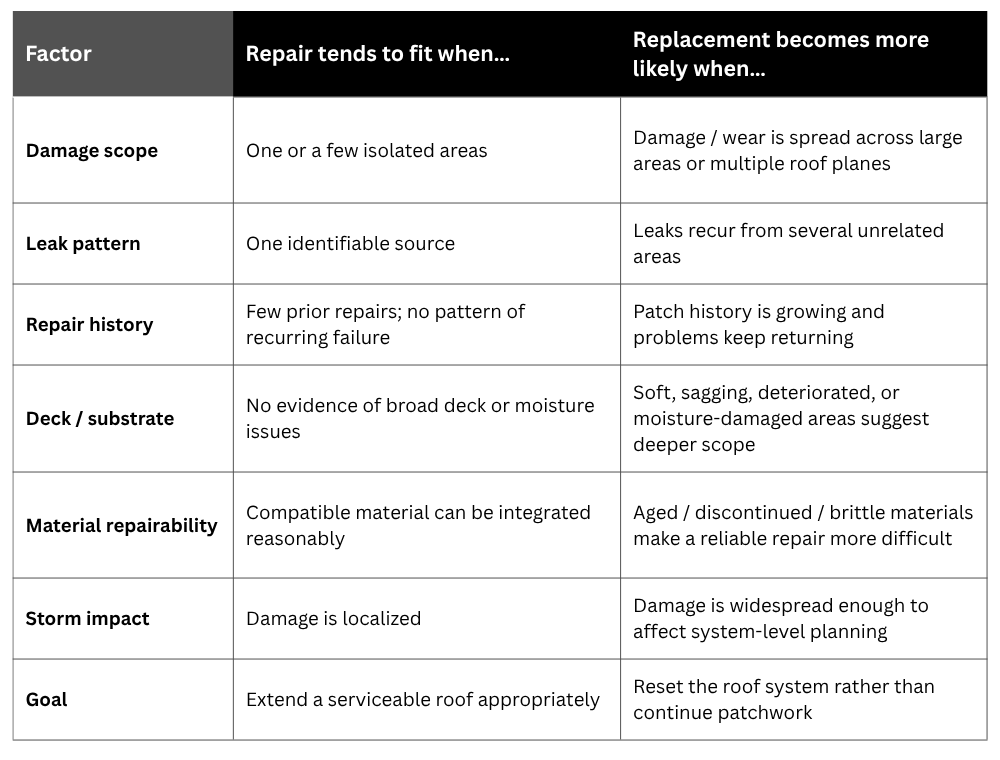
This table helps you understand the logic. It is not a diagnosis. The actual roof condition determines the recommendation.
The Factors That Actually Change the Decision
The question is not simply whether a repair can be made. The better question is whether the repair is appropriate for the surrounding roof condition and likely to give the homeowner a practical next step.
1. Extent of damage
2. Roof age / serviceability
3. Leak history
4. Repair history
5. Shingle / material condition
6. Deck / hidden conditions
7. Storm involvement
Licensed public adjuster
When a Targeted Roof Repair Makes Sense
A repair is often the right answer when the problem is limited, the surrounding roofing system is still serviceable, and the repair can address the actual source without creating unnecessary work.
- The leak traces back to one repairable flashing, penetration, valley, edge, or shingle area.
- A small number of shingles are missing, lifted, cracked, or damaged while the surrounding roof remains in good condition.
- Storm or impact damage is limited to a repairable area rather than spread broadly across the roof.
- The roof deck / substrate does not show evidence of widespread deterioration based on what can be inspected.
- Past repairs are limited and the roof does not have a pattern of recurring failures in multiple areas.
- Compatible replacement materials can be integrated reasonably with the existing roof.
- The repair is expected to address the cause—not simply cover the visible symptom.
If the roof is otherwise serviceable, CGR is comfortable recommending a repair instead of turning every problem into a replacement project.

When Roof Replacement Becomes the More Practical Option
Replacement becomes more reasonable when the problem is no longer isolated or when the existing roof system makes continued patching increasingly difficult, unpredictable, or short-lived.
- Leaks keep returning from different areas or several roof details are failing.
- Shingle wear or deterioration is widespread rather than limited to one repair zone.
- Large areas show cracking, curling, brittleness, excessive granule loss, or other age-related wear.
- Storm damage or wind damage is broad enough that a targeted repair would not address the overall roof condition.
- Soft, sagging, deteriorated, or moisture-damaged decking / substrate suggests a larger scope.
- The roof has accumulated enough prior repairs that another patch is unlikely to solve the broader pattern.
- Existing materials are difficult to repair cleanly because of product discontinuation, weathering, brittleness, or integration issues.
- The homeowner would gain more practical value from resetting the roofing system than continuing a cycle of patchwork repairs.
Replacement should be presented as a roof-condition decision—not the default sales answer.
Repair Now, Monitor, or Plan Replacement
Start with the service that best matches your situation, or book an inspection if you are not sure yet.
Monitor / no immediate work
Targeted repair
Repair + replacement planning
Full replacement
Why a “small” repair is not always simple
A repair decision is not based only on the square footage of visible damage. The surrounding roofing material has to tolerate the repair, new material has to integrate with the existing system, and the contractor may need to determine whether hidden conditions expand the scope.
- Weathered shingles can look different from new replacement shingles even when the closest current color is used.
- Manufacturers may change or discontinue products and colors over time.
- Aged or brittle shingles around the repair area can make lifting / integration more difficult and may increase the repair zone.
- A ceiling stain does not always sit directly below the roof entry point; water can travel before it becomes visible.
- Decking, underlayment, or hidden moisture conditions may not be fully visible until affected roofing material is opened.
- Aesthetic mismatch and technical repairability are separate issues, so CGR does not promise a perfect visual match.
What If the Damage Happened During a Storm?
Storm damage changes what needs to be inspected, but it does not automatically answer repair vs. replacement. The construction decision still depends on how much of the roof was affected, where the damage is located, the condition of the existing roof, and what repair is practical.
Localized wind or impact damage may still be repairable.
Widespread hail / wind conditions may shift the discussion toward broader restoration or replacement.
Pre-existing wear and storm-related damage should be documented separately and explained clearly.
If the homeowner files a claim, the insurance carrier determines coverage and payment under the policy.
CGR can inspect / document roofing conditions and explain the construction scope without promising claim outcomes.
Repair vs. Replacement Cost: Compare the Roof Condition, Not Just the Price Tag
A repair usually has a lower upfront cost than replacing the full roof. But the lowest immediate price is not automatically the best value if the roof is already requiring repeated work. At the same time, a higher replacement price does not make replacement the right answer when a targeted repair can solve the actual problem.
What will this repair actually solve?
– A repair that addresses the root cause is different from another patch on a failing pattern.
How much of the roof remains serviceable?
– A healthy surrounding roof supports repair; broad deterioration changes the economics.
How many repairs have already been made?
– Repeated work can make continued patching less practical.
How long do you plan to own the home?
– Near-term sale, long-term ownership, and budgeting goals can affect the decision.
Are financing / cash-flow options relevant?
– Replacement may be easier to plan when financing is available, but financing should not be used to push unnecessary replacement.
Could hidden conditions change the scope?
– Decking or underlying damage may not be fully known until affected areas are opened.
What a Roof Inspection Should Determine
- Where is the actual problem located?
- Is the condition isolated or widespread?
- What is the condition of the surrounding shingle field and roof details?
- Are flashing, valleys, penetrations, edges, vents, or other transitions contributing?
- Is there visible evidence of deck / moisture / structural concern that changes the scope?
- How much repair history is present?
- Did storm conditions contribute?
- Can the existing materials be repaired and integrated reasonably?
- What are the legitimate next-step options: monitor, repair, repair + plan, or replace?
Real CGR Decision Proof
- City / market
- Service and homeowner problem
- What CGR found
- Work completed and result
- City / market
- Service and homeowner problem
- What CGR found
- Work completed and result
Homeowner Questions Worth Answering
Can a roof be repaired instead of replaced?
Yes. Localized leaks, flashing problems, missing shingles, or limited storm damage may be repairable when the surrounding roof remains serviceable. The inspection should confirm whether the repair can address the actual cause.
Does an older roof automatically need replacement?
No. Age is one factor, not a diagnosis. Condition, damage extent, leak history, repair history, material repairability, and the overall roofing system matter too.
Can one missing or damaged shingle be repaired?
Often, localized shingle damage can be repaired. The surrounding shingles still need to be in a condition that allows a proper repair, and the closest replacement material may not look identical on a weathered roof.
What if my roof has been repaired several times already?
Repeated repairs do not automatically require replacement, but they are an important signal. If problems keep returning in different areas, the cost and practicality of continued patching should be compared with replacement.
Does storm damage mean I need a full roof replacement?
Not necessarily. Storm damage can be localized or widespread. A roof inspection helps document the affected areas and determine whether repair or broader work makes sense. Insurance coverage is a separate decision made by the carrier.
Can I repair the roof now and replace it later?
Sometimes. If the current issue is repairable but the roof is aging, a targeted repair may solve the immediate problem while you plan and budget for future replacement. The repair should still make technical and financial sense.
Is roof replacement always more expensive than repair?
Replacement generally has a higher upfront cost because it involves the full roofing system. The better comparison is whether a repair solves the actual problem and how likely the roof is to need additional work over your ownership horizon.
How do I know which option is right for my roof?
Start with an inspection that documents the condition, damage scope, repair history, surrounding material condition, and likely next-step options. CGR’s goal should be to explain why a repair, monitoring plan, or replacement does—or does not—make sense.